
The Best Fluffy Pancakes recipe you will fall in love with. Full of tips and tricks to help you make the best pancakes.

At about 12:30 p.m. on January 15, 1919, residents of Boston’s North End heard a sound like machine-gun fire. Steel rivets the size of fists tore loose from a 50-foot tank on Commercial Street and shot through the air. Then came the wave: 2.3 million gallons of dark molasses, more than 25 feet high, moving through the streets at 35 miles per hour. Within minutes, 21 people were dead and roughly 150 were injured. The Great Molasses Flood sounds like a punchline until you learn how the people in its path actually died.
TL;DR — Why the Great Molasses Flood killed 21 people
The Great Molasses Flood killed 21 people because a defective, never-inspected steel tank ruptured on a cold January day, and the frigid air turned the escaping molasses into a thickening, cement-like mass that trapped and suffocated victims faster than rescuers could reach them. A six-year inquiry later found the tank’s owner fully responsible.
Key Facts
- When: January 15, 1919, around 12:30 p.m.
- Where: 529 Commercial Street, North End, Boston
- What failed: A 50-foot steel tank operated by Purity Distilling, a subsidiary of United States Industrial Alcohol (USIA)
- Scale: ~2.3 million gallons released; wave roughly 25 feet high, moving ~35 mph
- Toll: 21 dead, ~150 injured
- Why the molasses was there: USIA fermented it into alcohol for World War I munitions, then for post-war rum ahead of Prohibition
- The verdict: Auditor Col. Hugh W. Ogden ruled in April 1925, after 341 hearing days and roughly 3,000 witnesses, that USIA’s negligent tank construction caused the disaster
- The science: A 2016 Harvard study (Sharp, Kennedy, Rubinstein) found that cold air thickened the molasses mid-surge, which is why so many victims suffocated
What Happened on Commercial Street
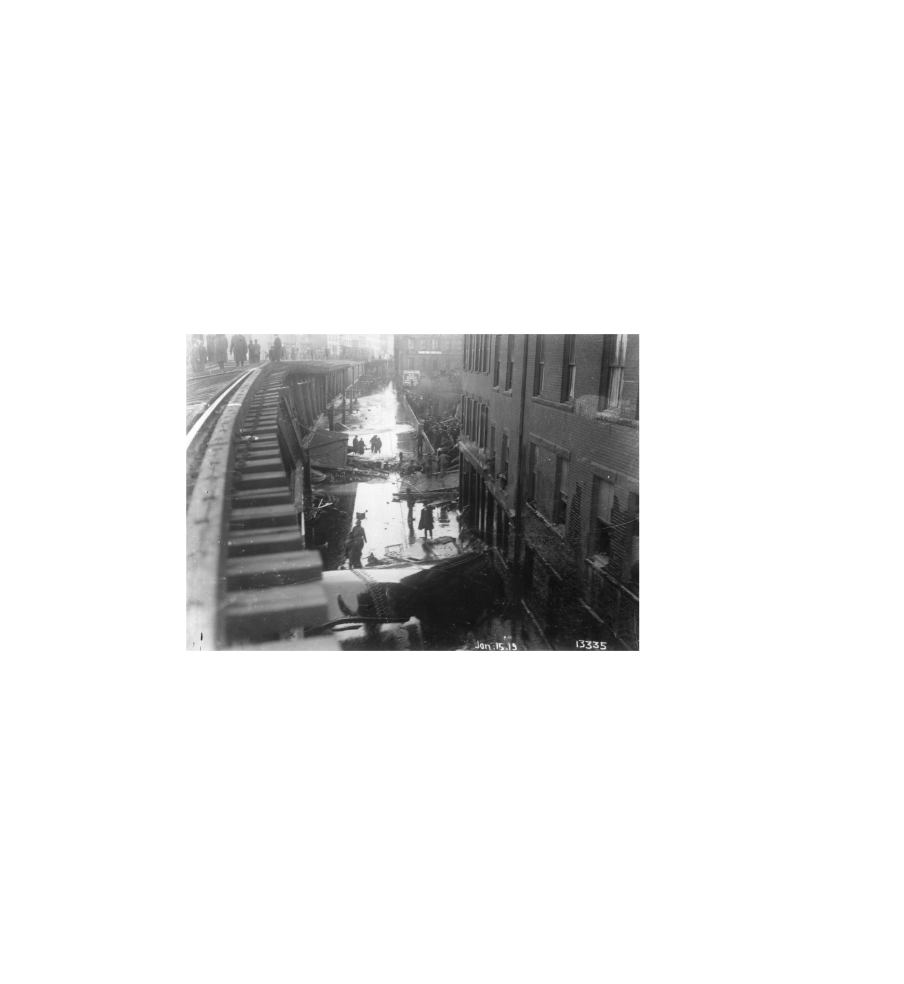
It was an unusually warm winter afternoon, above 40°F, after a hard cold snap. Dockworkers were unloading freight. Three children were scavenging firewood near the tank. Firefighters from Engine 31 were eating lunch in their station next door. Then the tank that had loomed over the waterfront since 1915 began to rumble.
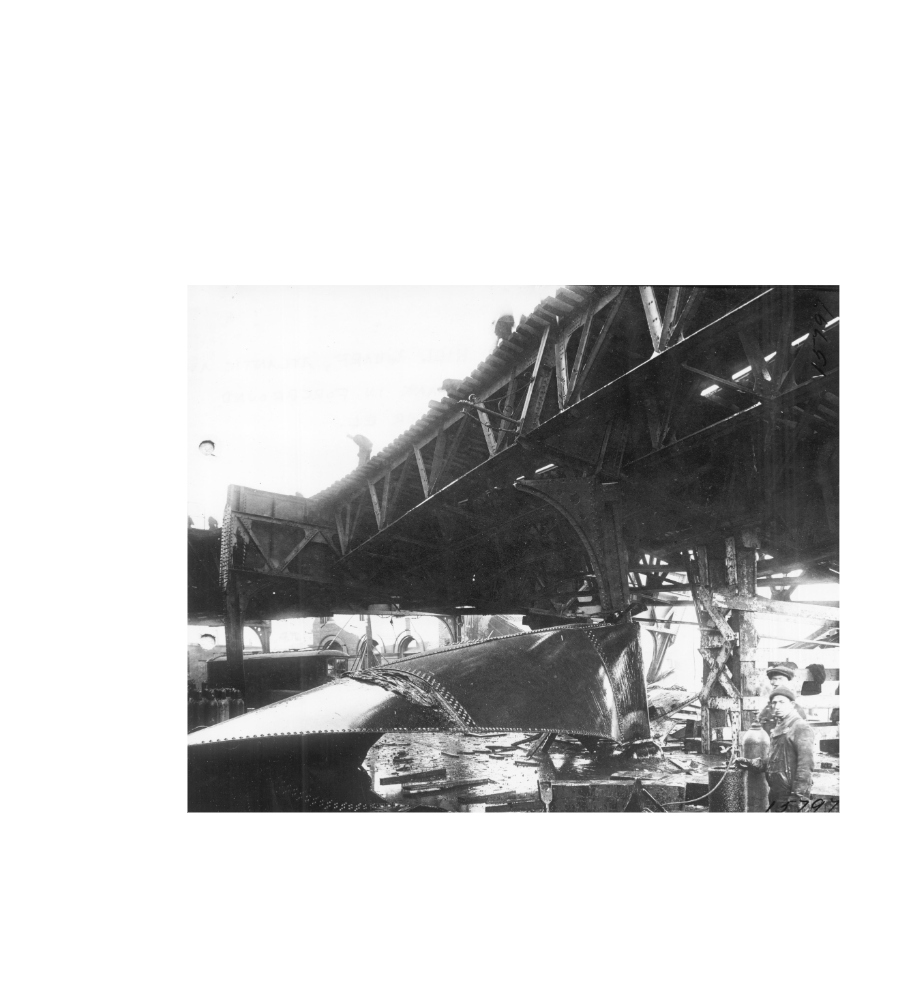
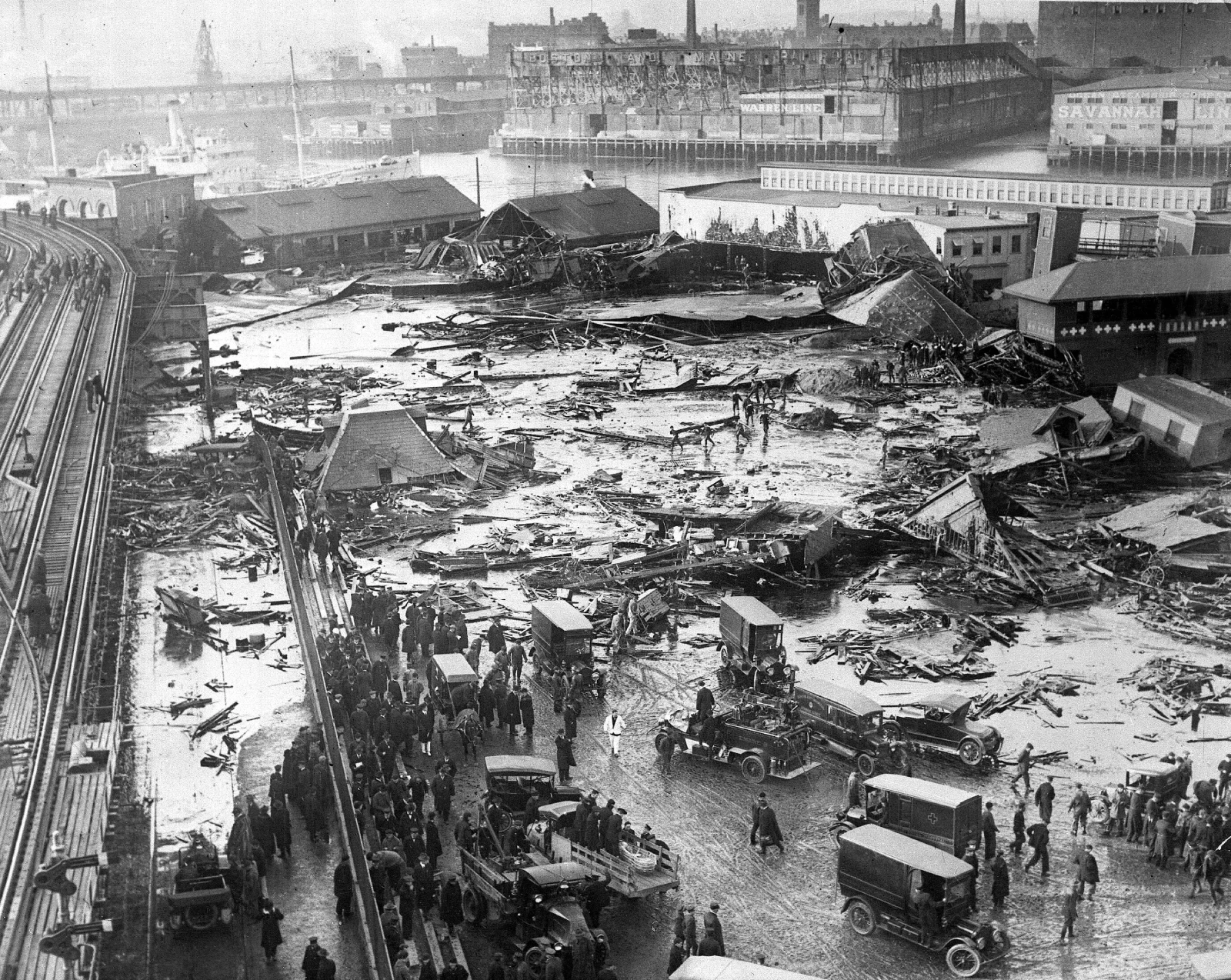
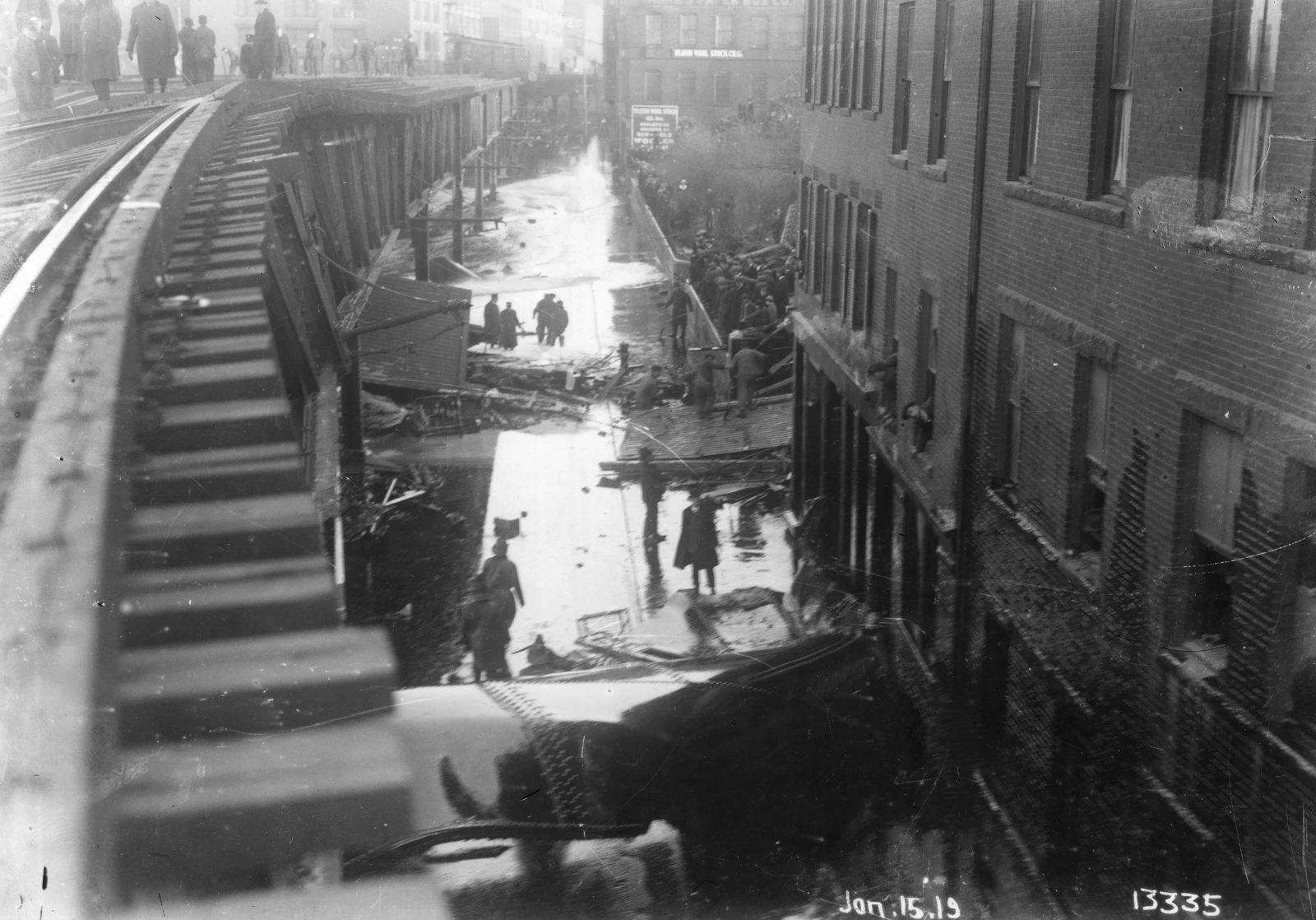
Witnesses described a deep metallic groan, then a tearing sound, then rivets popping loose and flying out like shrapnel. The wall gave way. The wave that followed lifted wagons off the cobblestones, snapped telegraph poles at the base, and threw a five-ton truck into a building. It shoved the Engine 31 firehouse off its foundation and buckled the steel supports of the elevated railway overhead, nearly derailing a passing train. The Boston Globe reported that buildings seemed to “cringe up as though they were made of pasteboard.”
What made it lethal was not just the speed. Survivors were caught in syrup that was already stiffening around them as they tried to claw free. Around 100 sailors from the USS Nantucket, docked nearby, joined police and firefighters in the rescue, wading into waist-deep molasses to pull people out. Crews eventually used saltwater pumped from the harbor to break the molasses down. The harbor itself ran brown for roughly six months.
| Measure | Detail |
|---|---|
| Date and time | January 15, 1919, ~12:30 p.m. |
| Volume released | ~2.3 million gallons (~8.7 million liters) |
| Wave height | Estimated 15–40 feet at peak |
| Wave speed | ~35 mph (~15 m/s) |
| Deaths / injuries | 21 / ~150 |
| Cleanup effort | ~87,000 worker hours |
For a sense of how a single catastrophe could reorder a city’s politics and law, it’s worth reading alongside the Tulsa Race Massacre of 1921, another early-1900s American disaster whose official accounting took generations to settle.
Why was the molasses wave so deadly?
The molasses was deadly because cold weather turned it into a trap. A 2016 Harvard study by Nicole Sharp, Jordan Kennedy, and Shmuel Rubinstein found that the molasses flowed fast while it was warm, then cooled and thickened mid-surge into a heavy, cement-like mass that pinned victims in place and made rescue nearly impossible. Half the dead suffocated.
The researchers, who presented their work at the American Physical Society’s Division of Fluid Dynamics meeting in Portland in November 2016, ran cold corn syrup through a scale model of the North End in a refrigerated room to mimic January 1919 conditions (Source: Boston Globe, 2016; APS, 2016). Molasses is a non-Newtonian fluid: it shear-thins, meaning it gets runnier under stress, so the initial surge moved like a fast liquid. It is also about 1.5 times denser than water and, at rest, thousands of times more viscous. As the wave spread across cold streets and the cold January air pulled heat out of it, that viscosity climbed sharply.
The grim result was a substance that behaved like a flash flood on impact and like quicksand a minute later. People who survived the wall of molasses were then held fast as it congealed around their chests and faces. The Harvard team’s conclusion reframes the whole event: a flood of the same size on a warm summer day would almost certainly have killed fewer people. The cold did not cause the disaster, but it sharply raised the body count.
Why Did the Purity Distilling Tank Fail?
The tank failed because it was rushed into service in 1915, built without engineering oversight, never properly tested, and then ignored for nearly four years while it visibly leaked. USIA put up the 50-foot tank to ferment molasses into industrial alcohol for the wartime munitions trade (specifically cordite). The project was overseen by Arthur P. Jell, an assistant treasurer with no engineering background who, by his own later admission, could not read a blueprint.
Jell hired Hammond Iron Works to build it and skipped the steps a competent engineer would have insisted on. No architect or engineer inspected the design. The only test before the tank was put into service was filling it with about six inches of water rather than running a full structural pressure test. The steel was too thin and contained too little manganese, which left it brittle in cold weather.
The warnings were impossible to miss. The tank leaked from its first filling. A USIA employee named Isaac Gonzales repeatedly raised the alarm, at one point dropping rust flakes that had fallen off the tank onto Jell’s desk, and by the summer of 1918 he was running through the streets at night, unable to sleep for fear the thing would burst. Rather than repair the leaks, the company had the tank painted brown in August 1918, which conveniently hid the seepage. Neighborhood children scooped leaked molasses for candy. Caulkers John Urquhart and Patrick Kenneally were sent up to seal the joints twice; Urquhart’s final attempt was on December 20, 1918.
On January 13, 1919, USIA pumped a fresh 600,000-gallon shipment of warm Caribbean molasses into the tank, filling it to near capacity. Two days later, it failed.
Who Were the Victims of the Boston Molasses Flood?
The 21 people killed were mostly working-class Italian and Irish immigrants: longshoremen, city paving crews, teamsters, a firefighter, and three children. They ranged in age from 10 to 76. Some drowned, some suffocated as the molasses hardened, and others were crushed by hurled debris or collapsing buildings. The bodies were so glazed and disfigured that several took days to identify, and one was not recovered from the harbor for four months.
The flood is often retold through a handful of names: 10-year-old Maria Distasio, buried near the base of the wrecked tank; 10-year-old Pasquale Iantosca, killed while collecting firewood; his friend Antonio di Stasio, age 8, who survived a head injury after being flung against a lamppost; and firefighter George Layhe, trapped in the crawlspace beneath the collapsed Engine 31 firehouse, who reportedly held his head above the molasses for hours before he suffocated. But the full roster matters, because the official fatality records put names and ages to a disaster that is too often played for laughs.
Here is the complete list of the 21 dead, compiled from the Boston.com “21 victims” feature and Wikipedia’s fatality table (Source: Boston.com, 2019; Wikipedia, fatality records):
| Name | Age | How they died |
|---|---|---|
| Patrick Breen | 44 | Laborer at the North End paving yard, caught at work |
| William Brogan | 61 | Teamster from East Boston |
| Bridget Clougherty | 65 | Crushed when her home collapsed |
| Stephen Clougherty | 34 | Bridget’s son; injured in the flood, died later |
| John Callahan | 43 | Paver at the North End paving yard |
| Maria Distasio | 10 | Buried under molasses barrels near the tank |
| William Duffy | 58 | Laborer and longtime city stone cutter |
| Peter Francis | 64 | Blacksmith from Charlestown; identified by his clothing |
| Flaminio Gallerani | 37 | Driver from Norwood; body found 11 days later under his truck |
| Pasquale Iantosca | 10 | Killed gathering firewood near the tank |
| James Kinneally | 48 | Laborer at the North End paving yard |
| Eric Laird | 17 | Express-company driver; found under a freight shed |
| George Layhe | 38 | Engine 31 firefighter, pinned under the wrecked firehouse |
| James Lennon | 64 | Paving Department foreman, killed when the lunch building fell |
| Ralph Martin | 21 | Supply-company driver, knocked down while unloading |
| James McMullen | 46 | Foreman for Bay State Express |
| Cesare Nicolo | 32 | Wagon driver; remains found under a wharf ~4 months later |
| Thomas Noonan | 43 | Longshoreman from Charlestown |
| Peter Shaughnessy | 18 | Teamster from South Boston |
| Michael Sinnott | 76 | Public Works messenger, thrown against paving stones |
| John Seiberlich | 69 | Blacksmith with 47 years of city service; died at a relief station |
Five of the dead were Boston Public Works employees who were caught at their wharf stable along with more than a dozen horses. The last victim, Cesare Nicolo, was not pulled from the harbor until May 12, 1919, four months after the flood.
Does Boston still smell of molasses?
No verified scientific evidence shows that molasses still remains in Boston’s North End a century later. What persists is a local legend: for decades, longtime residents have insisted that on hot summer days a faint sweetness rises off the old waterfront. It’s a charming claim, repeated by generation after generation, but nobody has ever confirmed it in a lab.
The story has staying power for understandable reasons. The harbor genuinely ran brown for about half a year after the flood, and the cleanup soaked into cobblestones, cellars, and pilings across the neighborhood. People who lived through that, and their children, grew up associating the area with the smell. Journalist Edwards Park is among those who recorded residents describing it on warm afternoons years afterward.
The honest version is this: the sensory memory is real, the affection for the story is real, and the molasses almost certainly is not still there in any detectable amount. It is one of those local myths that survives precisely because it can’t quite be disproven, and because it’s a kinder thing to believe than the body count.
The Six-Year Lawsuit That Reshaped American Engineering
The flood produced one of the largest civil suits in Massachusetts history to that point. More than 125 plaintiffs filed claims against USIA, and the cases were consolidated under the lead suit Dorr v. United States Industrial Alcohol Co., named for Dudley H. Dorr, a Commercial Street property owner and trustee who served as the lead plaintiff. The fight ran for roughly six years.
USIA’s lead attorney, Charles F. Choate Jr., built his defense around a sabotage theory: he argued that Italian anarchists had blown up the tank with a bomb. It was a calculated play on the anti-Italian prejudice and first Red Scare paranoia of the era. The plaintiffs’ attorney, Damon Hall, countered with hard engineering, including a structural survey by MIT professor C.M. Spofford and testimony from the caulkers, sailors, and Gonzales.
The case is also a footnote in the history of American law firms. Dudley Dorr’s firm, Hale & Dorr, had been founded in Boston only in 1918, by Richard Hale, Dudley Huntington Dorr, and three other partners (Source: Wikipedia, WilmerHale entry). The young firm’s involvement in the marathon molasses litigation is part of its early lore, and Hale & Dorr went on to become one of the country’s major firms before merging in 2004 with Wilmer, Cutler & Pickering to form WilmerHale (Source: Wikipedia, WilmerHale entry; WilmerHale company history). The auditor who presided over the evidence, Col. Hugh W. Ogden, was himself an attorney and a World War I veteran, and the case became a defining test of whether a corporation could be held accountable for an industrial death toll.
Over 341 hearing days spread across three years, Ogden reviewed roughly 25,000 pages of testimony from about 3,000 witnesses. In April 1925 he filed his report. He rejected the anarchist theory outright and found USIA fully liable, concluding that the tank had been rushed, untested, and built by people who could not read the plans (Source: Mass Moments; Pacific Standard). Historian Stephen Puleo, whose 2003 book Dark Tide is the definitive account, described Ogden as “grounded in a sense of fairness and justice.”
USIA was ordered to pay roughly $1 million in damages — about $18 million in today’s dollars. In practice, the company distributed around $628,000 across some 120 claims, a sum historian Stephen Puleo totals at close to $7 million in present-value settlements. The lasting consequence was not the money. In the wake of the verdict, Massachusetts and then other states began requiring that licensed engineers and architects sign and seal construction plans, closing the exact regulatory gap that had let an untested tank go up in a crowded neighborhood (Source: NSPE; Massachusetts Secretary of the Commonwealth).
Could a disaster like this happen again?
A repeat is far less likely today, and the reason traces directly back to this flood. The collapse exposed a regulatory void: in 1919, no law required a qualified engineer to design, inspect, or certify a structure like the Purity Distilling tank. The litigation that followed pushed Massachusetts, and then many other states, to require licensed professional engineers to review, sign, and seal major construction plans (Source: NSPE; Massachusetts Secretary of the Commonwealth).
That reform sits inside a broader shift already underway. Wyoming had passed the first US engineering licensure law in 1907, largely over water and irrigation surveying, and issued the country’s first professional engineering license that year (Source: NSPE, “100 Years of Engineering Licensure”). The molasses verdict gave that movement a vivid, deadly justification and accelerated its spread into structural and building work. The principle that hardened into law afterward is the one every modern engineer lives by: a licensed professional must put their name, stamp, and legal liability on the design.
On the engineering side, the specific failure points are now covered by standards that didn’t exist in 1915. Large storage tanks are typically governed by codes such as the American Petroleum Institute’s API 650 for welded tanks (first published in 1961), which dictate plate thickness, weld quality, and testing. Tanks are hydrostatically tested at full load before service, the opposite of Jell’s six-inch water check. Steel chemistry is specified so material stays ductile rather than turning brittle in the cold, the very flaw the 1919 steel had. Permitting, third-party inspection, and recurring structural review are mandatory rather than optional.
None of that makes catastrophic failure impossible; tanks still rupture when companies cut corners or defer maintenance. What changed is that the gaps the molasses flood drove a wave through, no engineer of record, no real test, no inspection, no consequences, are no longer legal to ignore.
This same arc, from unregulated industrial labor to hard-won accountability, runs through other corners of the era. The crews who built the country’s infrastructure under brutal conditions, such as the Chinese and Irish workers of the transcontinental railroad, paid much of the price for that lack of oversight.
What Most Sources Get Wrong
Popular retellings frame the flood as a freak accident: a warm shipment plus a cold snap, bad luck, nobody’s fault. The evidence supports almost the opposite reading on both counts.
First, the cold did not just happen to be present; it made the disaster measurably worse. The 2016 Harvard work by Sharp, Kennedy, and Rubinstein showed that the molasses thickened as it cooled, hardening around victims like quicksand and turning survivable injuries into fatal entrapments. The “freak weather” framing actually undersells how central the temperature was to the death toll.
Second, the warm-shipment narrative quietly erases four years of negligence. The tank leaked from day one. A worker begged the company to act and was ignored. No engineer ever signed off on the design. The leaks were painted over instead of fixed. By the time USIA topped the tank off on January 13, 1919, the failure was not a surprise waiting to happen; it was a near-certainty that had been deferred. The cold was the multiplier. The negligence was the cause.
Why the Great Molasses Flood Still Matters
The flood matters because it marks the moment American law stopped treating industrial safety as optional. The site at 529 Commercial Street is now Langone Park and Puopolo Park, marked by a small Bostonian Society plaque that’s easy to walk past. The neighborhood legend about the smell survives. But the durable legacy is legal and structural.
Ogden’s 1925 verdict helped move the country from a world where a corporation could build an untested tank over people’s heads and face no consequences, to one where permitting, inspection, and a licensed engineer’s seal are the price of doing business. Every signed-and-sealed blueprint carries a little of that ruling in it. For another case study in how the state’s power can be turned against ordinary people, and how long accountability can take to arrive, see the WWII incarceration of Japanese Americans.
Frequently Asked Questions
What caused the Great Molasses Flood?
A defective 50-foot steel tank owned by United States Industrial Alcohol ruptured on January 15, 1919. The tank was built in 1915 without engineering oversight, never properly pressure-tested, made of steel that was too thin and brittle, and had leaked for years before it failed.
How many people died in the Great Molasses Flood?
Twenty-one people were killed and about 150 were injured. The dead ranged from 10 to 76 years old and were mostly Italian and Irish immigrant laborers, including three children and one firefighter.
How fast was the molasses wave?
The wave moved at roughly 35 mph because warm molasses shear-thins and flows like a fast liquid. A 2016 Harvard study found it then cooled and thickened mid-surge, which is why it stayed deadly long after the initial wall of molasses passed.
Can you still smell molasses in Boston today?
There is no scientific confirmation that molasses remains in the North End a century later. For decades, residents have claimed they catch a faint sweetness on hot days, but it has never been verified. The harbor did run brown for about six months after the flood.
Could a molasses flood happen again?
It is far less likely. The disaster pushed Massachusetts and other states to require licensed engineers to sign and seal construction plans, and modern tanks must meet standards like API 650 and pass full hydrostatic testing before use. The regulatory gaps that allowed the 1919 tank no longer exist.
Is the Great Molasses Flood story true?
Yes. It is a thoroughly documented event with extensive newspaper coverage, an official six-year inquiry, court records, and a 2016 Harvard physics study. Twenty-one people genuinely died under a wave of molasses in Boston’s North End on January 15, 1919.
Sources
- Mass Moments — Hugh Ogden Issues Report on Cause of the Molasses Flood
- Boston.gov — 100 Years Ago Today: Molasses Crashes Through Boston’s North End
- Encyclopaedia Britannica — Great Molasses Flood
- American Physical Society — Sharp, Kennedy & Rubinstein, “The Physics of the Boston Molasses Flood” (2016)
- Boston Globe — Harvard Scientists Dig Into the Fluid Dynamics Behind the Molasses Disaster (2016)
- Stephen Puleo — Dark Tide: The Great Boston Molasses Flood of 1919
- Boston.com — The 21 Victims of the Great Boston Molasses Flood
- Wikipedia — Great Molasses Flood (fatality table)
- Wikipedia — Wilmer Cutler Pickering Hale and Dorr (firm history)
- WilmerHale — Firm History
- National Society of Professional Engineers — 100 Years of Engineering Licensure
- Massachusetts Secretary of the Commonwealth — The Boston Molasses Flood
- HISTORY — The Great Molasses Flood of 1919
- Pacific Standard — How the Boston Molasses Disaster Ushered in the Era of Modern Regulation