
The Best Fluffy Pancakes recipe you will fall in love with. Full of tips and tricks to help you make the best pancakes.

TL;DR — Why Was the Halifax Explosion So Powerful?
The Halifax Explosion was so powerful because the SS Mont-Blanc was packed with roughly 2,925 tonnes of explosives — most of it picric acid. A fire in the ship’s benzol fuel heated that cargo until it detonated all at once, releasing about 2.9 kilotons of energy: the largest human-made blast the world had seen before the atomic bomb.
Table of contents
Why Was the Halifax Explosion So Powerful?
Three things stacked on top of each other. First, the sheer mass: nearly 3,000 tonnes of high explosive in one hull. Second, the chemistry. Picric acid, the main cargo, is a touch more powerful and more sensitive than TNT, and it becomes far more dangerous when it dries out or reacts with metal. Third, the trigger: a benzol fire that cooked the cargo for twenty minutes until it went off in a single detonation rather than a slow burn. Get all three in one ship in one harbour, and you get an explosion measured at roughly 2.9 kilotons of TNT (Source: The Canadian Encyclopedia).
What Made One Ship Explode Like a Small Nuclear Bomb?
Cargo mass plus chemistry plus a sustained fire. The Mont-Blanc carried about 2,925 tonnes of military explosives — picric acid, TNT, and guncotton — with volatile benzol fuel stacked in drums on the deck. When the benzol ignited and burned long enough to detonate the hold, the ship released energy equal to roughly 2.9 kilotons of TNT (Source: Naval History Magazine). That is about one-fifth the yield of the Hiroshima bomb, and until August 1945 it stood as the most powerful explosion humans had ever engineered.
Inside the Mont-Blanc: A Cargo Manifest Built to Burn
The Mont-Blanc was, in effect, a floating munitions dump loaded to the rails in New York and bound for the Western Front. Every major item in its hold was designed to explode; the one item on deck was designed to burn. That combination is the whole story.
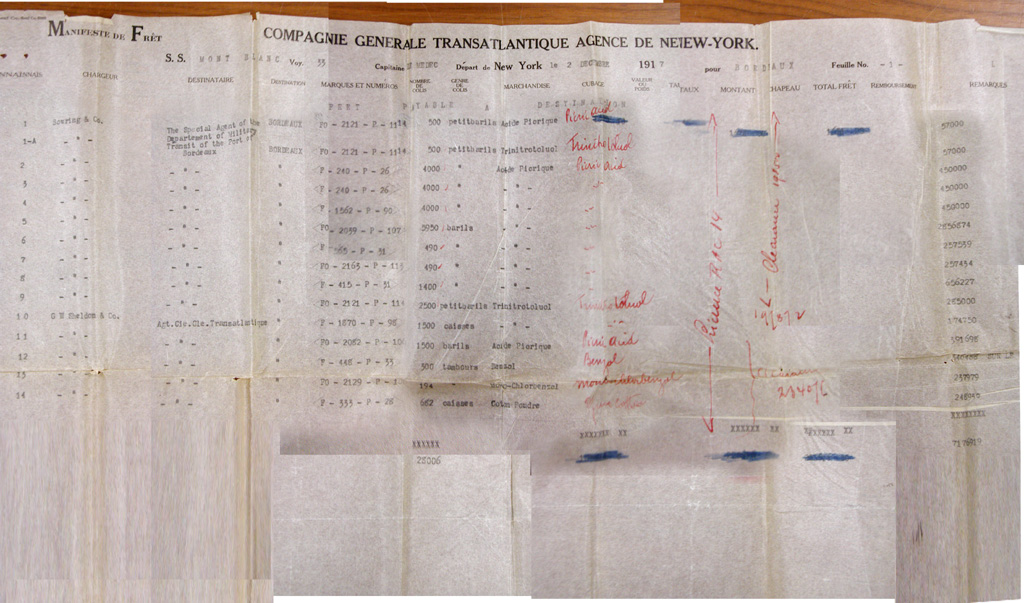
| Cargo | Tonnage | Role |
|---|---|---|
| Picric acid (wet + dry) | 2,367 t | Primary high explosive |
| TNT | 250 t | High explosive |
| Guncotton | 62 t | Explosive |
| Benzol (drums, on deck) | 246 t | Volatile fuel — ignition source |
| Approx. total | ~2,925 t |
Figures are drawn from the ship’s manifest as reported in contemporary and modern accounts (Source: Naval History Magazine; Science History Institute).
One correction worth flagging: a lot of popular retellings put the benzol at around 35 tonnes. The manifest figure is roughly 246 tonnes, and the fuel load was the fuse.
The Chemistry: Why Picric Acid Turned a Fire Into a Detonation
Picric acid — trinitrophenol, or TNP — was the workhorse shell filler of the First World War, and it behaves in ways that made the Mont-Blanc uniquely dangerous. On its own, wet picric acid is stable enough that it is deliberately shipped and stored damp; water desensitizes it, which is why part of the Mont-Blanc’s load was classed as “wet” (Source: Transport Canada). Dry it out, though, and its character changes. Dry picric acid is highly sensitive to heat, shock, and friction, and detonates with slightly more force than TNT (Source: Science History Institute).
The more insidious hazard is what happens when picric acid meets metal. The acid reacts readily with metals — iron, copper, lead, zinc — to form metal picrate salts, and those salts are markedly more sensitive than the parent acid (Source: Transport Canada). Some picrates are sensitive enough to serve as primary explosives in ammunition primers (Source: Transport Canada). That is exactly why safety authorities still warn against storing picric acid in metal containers or letting it dry on metal fittings.
Now picture the inside of a wartime freighter: a steel hull, steel bulkheads, iron fittings, and thousands of tonnes of picric acid. As the benzol fire raged above, it drove off moisture and heated the hold. Wet picric acid dried into its touchy state, and wherever acid had contacted the ship’s ironwork, primer-like picrate salts were waiting. A cargo that would normally need a deliberate detonator was, by 9:04 a.m., a hold full of material ready to go off from heat alone. The fire did more than ignite the cargo. It dried the picric acid and drove it against the ship’s iron, leaving a hold primed to detonate from heat alone.
Collision in the Narrows
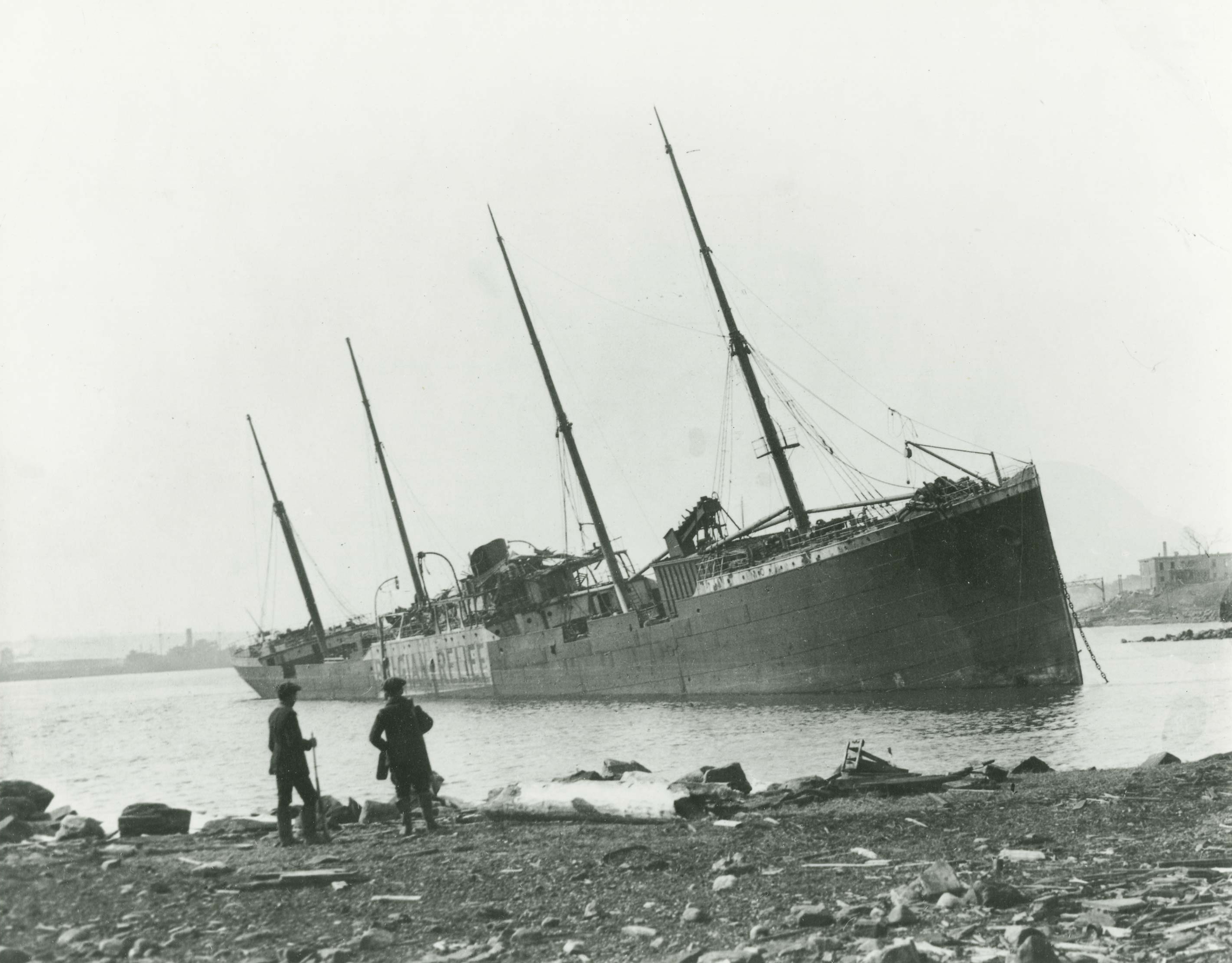
The disaster began with a slow, almost gentle collision. At about 8:45 a.m. on December 6, 1917, the inbound French freighter Mont-Blanc and the outbound Norwegian relief ship Imo met in the Narrows, the tight channel linking Halifax Harbour to Bedford Basin (Source: The Canadian Encyclopedia). A muddle over which vessel would pass on which side left them on a converging course. Both cut engines and reversed, but the Imo’s bow still ground into the Mont-Blanc’s starboard side.
The impact itself was minor, a low-speed nudge that crumpled plating and would not have sunk either ship. What made it catastrophic was where it happened: right against the benzol drums lashed on the Mont-Blanc’s deck.
Twenty Minutes of Fire
The collision ruptured benzol drums, and sparks from the grinding steel set the spilled fuel alight almost at once. Flames raced across the deck faster than the crew could fight them. Captain Aimé Le Medec, knowing precisely what sat below, ordered his men into the lifeboats; they rowed hard for the Dartmouth shore and abandoned the burning ship (Source: The Canadian Encyclopedia).
Nobody left aboard could warn the city, and nobody watching from the piers understood what they were looking at. The unmanned Mont-Blanc drifted across the harbour and nudged up against Pier 6 on the Halifax side, its cargo cooking the whole way. Crowds gathered at windows and along the waterfront to watch the spectacle. For roughly twenty minutes the ship burned, and then the hold caught.
9:04:35 a.m.: The 2.9-Kiloton Detonation
At 9:04:35 a.m. the Mont-Blanc detonated in a single blast of about 2.9 kilotons (Source: Naval History Magazine). The ship was vaporized. Its cargo went off effectively all at once, generating a fireball that reached an estimated 5,000 °C (9,000 °F) and a shockwave that tore outward faster than sound.
The debris tells you how much energy was released. Chunks of the Mont-Blanc were thrown across the city and beyond it: part of the ship’s anchor shank, a piece weighing over half a tonne, was hurled about 2.35 miles (roughly 3.8 km) from the blast, while one of its gun barrels came down miles away in the opposite direction (Source: Naval History Magazine). A 3,000-tonne steel freighter was disassembled and scattered across the landscape in a fraction of a second.
The Wave That Followed
The blast displaced so much water that it briefly bared the harbour floor, then flung the sea back as a tsunami. The wave rose as high as about 18 metres (59 ft) above the high-water line and swept over the low shores of the Narrows (Source: Halifax Public Libraries).
It fell hardest on Tuft’s Cove, a Mi’kmaq community (also recorded as Turtle Grove) on the Dartmouth side, directly across from the blast. The settlement was destroyed outright; only a handful of residents survived, and it was never rebuilt (Source: Halifax Public Libraries). A community that had lived on that shoreline for generations was erased in the space of a morning, one of the least-remembered losses of the disaster.
Halifax vs. Hiroshima: How Do They Compare?
No — Halifax was not bigger than an atomic bomb, though it was in the same conversation. The Mont-Blanc released about 2.9 kilotons of energy; the Hiroshima bomb released roughly 15 kilotons (Source: Britannica). Halifax was about one-fifth of Hiroshima’s yield.
| Event | Approx. yield | Notes |
|---|---|---|
| Halifax Explosion (1917) | ~2.9 kt TNT | Largest human-made blast before the atomic age |
| Hiroshima “Little Boy” (1945) | ~15 kt TNT | First atomic bomb used in war |
The comparison matters because of the ranking, not the ratio: from December 1917 until the Trinity test and Hiroshima in 1945, the Halifax Explosion was the most powerful explosion ever produced by human hands.
Blast Radius, and the Human Cost
Nearly everything within an 800-metre (half-mile) radius was obliterated, and more than 400 acres of Halifax’s north-end Richmond district were leveled (Source: Canadian War Museum). The pressure wave shattered windows in towns tens of kilometres away and was felt far beyond the harbour. Where it hit hardest, wood-frame homes were not knocked down so much as taken apart.
The toll was staggering for a city of around 50,000. At least 1,782 people were killed — by the blast itself, by flying debris, by collapsing buildings, and by the fires that broke out in the wreckage — and roughly 9,000 more were injured (Source: Canadian War Museum). Many of the wounds came from glass: people had crowded to their windows to watch the burning ship, and the shockwave turned those panes into shrapnel. Around 200 people were permanently blinded, and surgeons removed 249 ruptured eyes in the days that followed. The eye injuries were so numerous that they helped advance the treatment and care of the blind in Canada for years afterward. For a sense of scale, the disaster killed more people in nineteen seconds than many battles of the war it was feeding.
Vince Coleman Stayed at His Key
One of the day’s clearest acts of courage came from a railway telegraph office. Patrick Vincent “Vince” Coleman, a train dispatcher for the Canadian Government Railways, was warned that the burning ship in the harbour was a munitions carrier about to blow. He knew an inbound passenger train, carrying an estimated 300 people, was due into Richmond station (Source: Nova Scotia Museum).
Coleman went back to his key. His last message, tapped out as the ship burned toward its end, is preserved in several versions: “Hold up the train. Ammunition ship afire in harbour making for Pier 6 and will explode. Guess this will be my last message. Good-bye, boys.” The warning went out to stations along the line between Halifax and Truro; inbound trains were held, and Coleman is credited with turning back an incoming passenger train. He was killed at his post moments later (Source: Nova Scotia Museum). His decision to stay is one of the most-told stories of the disaster, and one of the few that ends in lives saved rather than lost.
Railways were the arteries of early-twentieth-century North America, built, run, and often died on by working people like Coleman and the crews who laid the transcontinental lines a generation earlier.
Who Was to Blame? A Verdict That Reversed Itself
Blame shifted three times as the case climbed the courts. The first inquiry, the Wreck Commissioner’s court under Justice Arthur Drysdale, ruled on February 4, 1918 that the Mont-Blanc was solely at fault and even recommended charges against its captain and pilot (Source: The Canadian Encyclopedia). That finding did not survive appeal.
On May 19, 1919, the Supreme Court of Canada reviewed the collision and found both ships to blame. The owners of the Mont-Blanc pushed the fight to the Judicial Committee of the Privy Council in London, which on March 22, 1920 upheld the shared-fault verdict: both the Mont-Blanc and the Imo were held equally responsible for the collision (Source: The Canadian Encyclopedia). It took more than two years for the legal system to land where the navigation facts pointed: two ships, one narrow channel, and a series of misread signals on both bridges.
Why Nova Scotia Still Sends Boston a Christmas Tree
Every December, Nova Scotia ships a giant evergreen to the city of Boston, and the reason traces straight back to 1917. Within hours of the explosion, Massachusetts organized relief: a train of doctors, nurses, and supplies left Boston that same night, arriving to help a city that had lost hospitals along with homes (Source: Nova Scotia Museum). Halifax sent a thank-you tree in 1918.
The gesture lapsed for decades, then was revived in 1971 and has continued every year since. The tree now stands on Boston Common as the city’s official Christmas tree, an annual, living receipt for aid rendered on the worst morning in Halifax’s history. It is a quieter kind of memorial than the disaster deserves, and a more durable one than most.
For a very different Boston catastrophe from the same era, see the Great Molasses Flood of 1919.
Frequently Asked Questions
Who was at fault for the Halifax Explosion?
Blame changed as the case was appealed. A 1918 inquiry ruled the Mont-Blanc solely responsible. In 1919 the Supreme Court of Canada found both ships at fault, and in 1920 the Judicial Committee of the Privy Council in London confirmed that verdict, holding the Mont-Blanc and the Imo equally to blame for the collision.
Was the Halifax Explosion bigger than the atomic bomb?
No. The Halifax Explosion released about 2.9 kilotons of energy, while the Hiroshima bomb released roughly 15 kilotons, so Halifax was about one-fifth as powerful. It was, however, the largest human-made explosion in history until the first atomic weapons were detonated in 1945.
Was there a tsunami after the Halifax Explosion?
Yes. The blast briefly exposed the harbour floor and threw the water back as a wave that reached about 18 metres above the high-water mark. It struck the Mi’kmaq community at Tuft’s Cove, on the Dartmouth shore directly opposite the ship, destroying the settlement, which was never rebuilt.
Who was Vince Coleman?
Vince Coleman was a railway train dispatcher in Halifax. Warned that the burning ship was a munitions carrier, he stayed at his telegraph to send a message down the line as an inbound passenger train carrying an estimated 300 people approached. Trains were held, and he is credited with turning one back. Coleman was killed at his post when the ship exploded.
Why does Nova Scotia send Boston a Christmas tree?
It is a thank-you for the relief Boston rushed to Halifax after the 1917 explosion, when Massachusetts sent doctors, nurses, and supplies within hours. Nova Scotia sent a tree in gratitude in 1918, revived the tradition in 1971, and has sent one every year since as Boston’s official Christmas tree.
Sources
- The Canadian Encyclopedia — “Halifax Explosion”: thecanadianencyclopedia.ca
- Naval History Magazine (U.S. Naval Institute) — “Havoc in Halifax”: usni.org
- Canadian War Museum — “The Halifax Explosion”: warmuseum.ca
- Transport Canada / CANUTEC — “Picric acid and picrate salts”: tc.canada.ca
- Science History Institute — “Picric Acid’s Volatile History”: sciencehistory.org
- Halifax Public Libraries — “Turtle Grove and the Halifax Explosion”: halifaxpubliclibraries.ca
- Nova Scotia Museum — “Vincent Coleman and the Halifax Explosion”: museum.novascotia.ca
- Encyclopaedia Britannica — “Little Boy” (Hiroshima yield): britannica.com