
The Best Fluffy Pancakes recipe you will fall in love with. Full of tips and tricks to help you make the best pancakes.

The Antikythera mechanism was a hand-cranked bronze calculator, built around the 2nd–1st century BCE and recovered from a shipwreck in 1901, whose interlocking gears encoded astronomy in their tooth counts. Turning the crank drove pointers that tracked the Sun, Moon, and calendar cycles. The ratios between gears were the computation.
TL;DR — What Made the Antikythera Mechanism Work?
How the Antikythera mechanism worked comes down to one idea: the ratio of teeth between meshing gears reproduces the ratio between astronomical periods. Turn the crank once and the main wheel advances roughly one solar year; a chain of gears then divides and multiplies that motion so separate pointers show the Moon’s phase, eclipse windows, and the 19-year calendar. No storage, no code. The geometry does the math.
Table of contents
What the Antikythera Mechanism Actually Was
The Antikythera mechanism is a corroded lump of bronze about the size of a shoebox, and it is the oldest known geared analog computer. Sponge divers pulled it from a Roman-era shipwreck off the Greek island of Antikythera in 1901, along with statues and other cargo (Source: Britannica, 2024). Most scholars date the device to roughly the 2nd–1st century BCE.
What survives today is fragmentary. X-ray and CT imaging reveal around 30 hand-cut bronze gears across the recovered pieces (Source: Britannica, 2024). Reconstructions that account for missing sections typically model closer to 37–40 gears, and some historical proposals have run higher still, up to around 69 in the most elaborate schemes. The original was housed in a wooden case with a bronze dial on the front and two large spiral dials on the back, hand-worked through a side crank.
Nothing of comparable mechanical complexity appears in the archaeological record for centuries afterward. Geared astronomical instruments at this level do not resurface until medieval clockwork. That gap is a big part of why the object fascinates engineers and historians alike.
How It Worked in One Turn of the Crank
Here is the mechanism’s logic reduced to a single input motion:
- You turn the side crank. A hand knob on the case is the only power source. Human muscle, nothing else.
- The crank drives the main solar gear. One full turn of the primary wheel corresponds to roughly one solar year of simulated time. That is the master clock everything else is measured against.
- The motion branches into gear trains. From that main wheel, chains of meshing gears carry the rotation off in several directions, each train dividing or multiplying the speed by a fixed ratio.
- Front pointers move. On the front face, separate hands track the Sun’s position through the zodiac, the Moon’s position and phase, and the date on an Egyptian 365-day calendar ring.
- Back dials advance. Two spiral dials on the back step forward through the long calendar and eclipse cycles, a small follower pin riding the groove of the spiral.
Crank forward, and the whole model of the sky moves in proportion. Crank backward, and it runs the heavens in reverse.
The Gear Train — Why Tooth-Count Ratios Became Astronomy
The core trick is simple enough to state in one sentence: a gear with X teeth driving a gear with Y teeth changes the rotation speed by the ratio X to Y. If a 20-tooth gear meshes with a 40-tooth gear, the larger one turns exactly half as fast. Mesh a third gear onto that, and its speed is set by a new ratio on top of the first. Chain several together and the ratios multiply.
That multiplication is the entire engine of the device. The builders picked tooth counts so that, after the motion passed through a train, an output shaft turned at a rate matching a real astronomical period.
Take the clearest example. Nineteen solar years equal almost exactly 235 lunar months. This is the Metonic cycle, and it is why the same Moon phases fall on the same calendar dates every 19 years. To build that relationship into bronze, you need a gear train whose combined ratio works out to 235 divided by 19. Feed in one solar year per crank turn and the Metonic pointer completes 235/19 of a turn, so after 19 turns it has counted exactly 235 lunar months. The astronomy is not looked up anywhere. It is the direct consequence of how many teeth the builder cut.
The eclipse dial does the same thing with a different number. The Saros eclipse period runs 223 lunar months, so a gear carrying 223 teeth (or a train that reduces to a factor of 223) will physically count out one Saros per full revolution. The tooth count is the cycle.
This is why calling the device a computer is fair rather than romantic. A modern computer represents numbers as electrical states; the Antikythera mechanism represents them as gear ratios. Change the teeth and you change the equation it solves. The Greeks who made it were, in a real sense, programming in metal, and the program was written the moment the teeth were filed.
What Each Dial Showed
The device split its output between a front face showing the current sky and a back face showing longer calendar and eclipse cycles. The table below maps each display to the cycle it tracked and the gearing logic behind it, in plain terms.
| Dial / display | What it shows | The cycle | Gear/tooth logic in plain terms |
|---|---|---|---|
| Front — Sun & zodiac | Sun’s position around the 360° zodiac ring and the date on an Egyptian calendar | One solar year | Main crank wheel geared 1:1 to the year; one crank turn ≈ one full trip around the zodiac |
| Front — Moon (epicyclic + pin-and-slot) | Moon’s position and phase, including its speed-up and slow-down | The lunar month, with variable speed | A gear mounted on another gear, linked by an off-center pin riding a slot, so output speed rises and falls each month |
| Front — planets (2021 Cosmos model) | Positions of Mercury, Venus, Mars, Jupiter, Saturn | Each planet’s synodic cycle | Shared epicyclic trains, tooth counts tuned to each planet’s period, packed into the shallow front |
| Back — Metonic | 19-year luni-solar calendar on a 5-turn spiral | 19 years = 235 lunar months | Train reducing to the ratio 235:19; pointer counts 235 months over 19 crank-years |
| Back — Callippic | Longer calendar correction | 76 years = 4 Metonic cycles | A subsidiary dial dividing the Metonic count by four for finer calendar accuracy |
| Back — Saros | Eclipse prediction on a 4-turn spiral, with glyphs for solar/lunar events | 223 lunar months ≈ 18 years 11⅓ days | A gear/train reducing to 223 physically counts one Saros per revolution |
| Back — Olympiad / Games | Four-year cycle naming Panhellenic games | 4 years | Simple 4:1 reduction off the main year motion |
Front: Sun, Zodiac, and the Egyptian Calendar
The front face was the “today” screen. A ring marked with the twelve zodiac signs sat behind a movable calendar scale of the 365-day Egyptian year, and pointers showed where the Sun sat against the stars on any given date. Because the crank turned the solar pointer once per simulated year, reading the front told you the season and the Sun’s place in the sky at a glance.
The Moon’s Variable Motion
The Moon does not move at a constant speed. It runs faster when closer to Earth and slower when farther away, an effect Greek astronomers of the Hipparchus era had already described. The mechanism reproduced this with a clever piece of engineering: one gear mounted slightly off-center on the face of another, connected by a pin that rode in a slot on the driven gear. As the pair rotated, the pin’s changing leverage sped the output up and slowed it down over each month. It is a mechanical translation of Hipparchus-era lunar theory, and it may be the single most sophisticated moving part in the whole device.
The 2021 UCL Cosmos Front Display
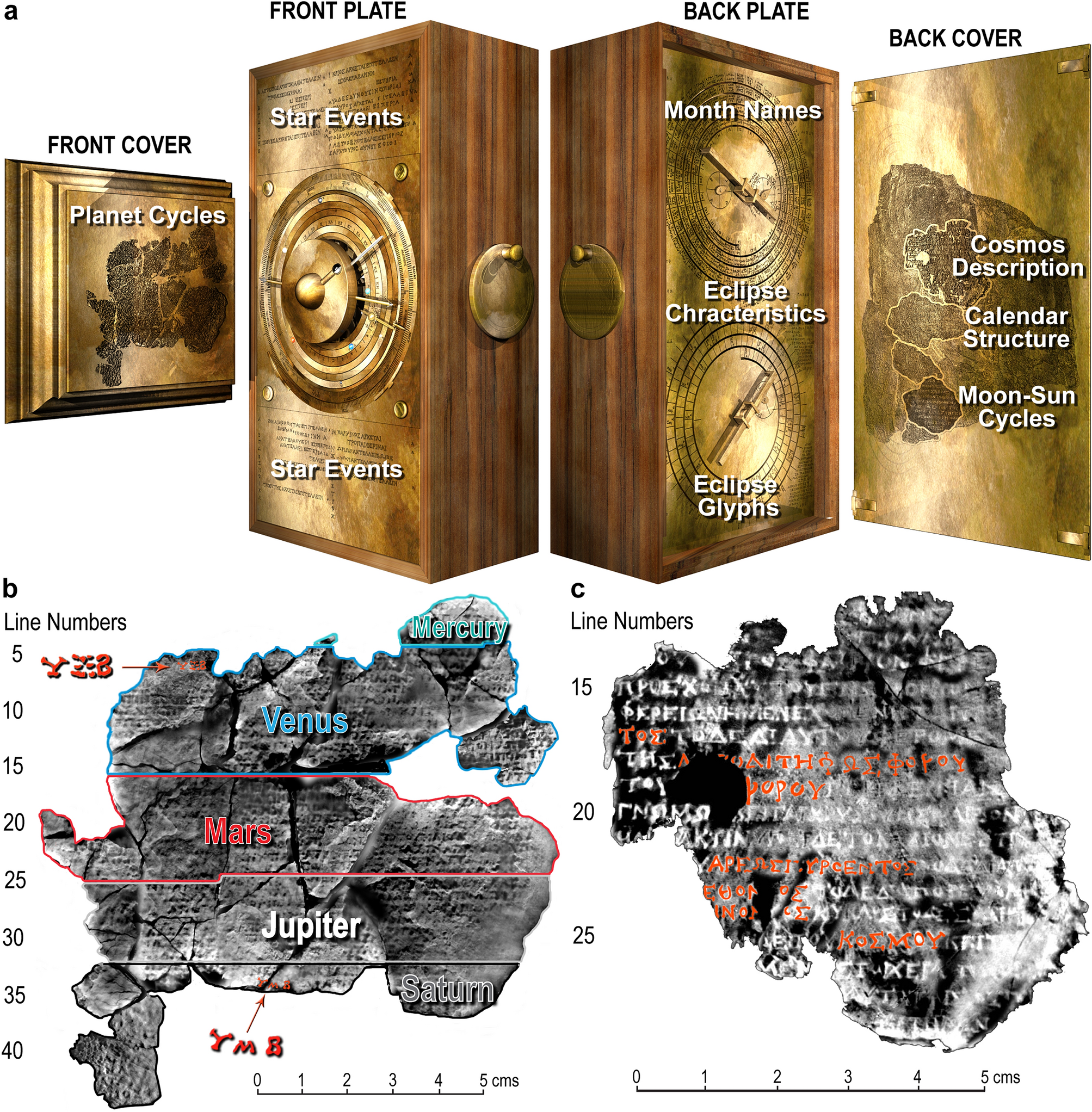
For decades the front planet display was a puzzle, because the surviving gears did not obviously account for the five planets. In 2021 a University College London team led by Tony Freeth published a reconstruction in Scientific Reports that resolved it (Source: Nature / Scientific Reports, 2021). Their model uses shared epicyclic gear trains so that Mercury, Venus, Mars, Jupiter, and Saturn could each be driven to the correct period while fitting inside the shallow, crowded space behind the front dial. Crucially, it was the first reconstruction that matches every surviving inscription on the device and conforms to all the physical evidence (Source: UCL News, 2021). It remains a proposed model, but it is the most complete account so far of what the front once showed.
The Back Dials: Metonic, Callippic, Saros, Olympiad
The back was where the long cycles lived. The upper spiral ran the 19-year Metonic calendar across five turns, with a subsidiary Callippic dial refining it over 76 years (four Metonic cycles). The lower spiral carried the 223-month Saros eclipse cycle over four turns, and a small Olympiad dial ticked off the four-year rhythm of the Panhellenic games, naming events like the Olympics. One machine, one crank, and every one of those calendars advanced in lockstep.
How Did It Predict Eclipses?
It predicted eclipses by counting the Saros cycle, the long-known fact that eclipses repeat in a similar pattern every 223 lunar months. That interval works out to about 6,585.32 days, or roughly 18 years, 11 days, and 8 hours (Source: Britannica, 2024). A gear train reducing to the number 223 stepped the Saros pointer forward, and glyphs inscribed in the spiral flagged which months carried a solar or lunar eclipse risk.
The device did not compute eclipses from physics. It pattern-matched against a cycle discovered empirically over centuries of observation. Much of that raw eclipse record came from Babylonian eclipse records, which Greek astronomers inherited and refined. The extra fraction of a day in the Saros — that awkward third of a day — is why eclipses in successive cycles shift westward around the globe, and the mechanism’s designers even appear to have accounted for it in the dial layout.
How Accurate Was It — and Where It Broke Down
For the cycles it modeled, the mechanism was elegant and, on paper, strikingly precise: the Metonic and Saros relationships it encoded are genuinely accurate to within a fraction of a day. The problem was never the astronomy. It was the metal.
Every hand-cut gear introduces small errors. Teeth are not perfectly spaced, meshing gears have play between them, and those tiny inaccuracies compound as motion passes down a long train. A 2025 simulation by engineers Esteban Szigety and Gustavo Arenas at Argentina’s National University of Mar del Plata modeled the device’s triangular gear teeth and realistic manufacturing tolerances. The result was unflattering: in about 90% of trials the mechanism jammed or its gears disengaged, often before the solar pointer had advanced even four months (Source: Live Science, 2025; Smithsonian, 2025). At that point a user would have to stop, free the mechanism, and reset.
So the honest verdict is split. As a piece of astronomical reasoning cast in bronze, it is remarkable. As a daily instrument, accumulated backlash and tooth error may have made it frustrating to actually run for long. It is possible the surviving imprecision reflects the limits of the study’s assumptions rather than the original build quality, but the reliability question is real and unresolved.
Who Built It, and When
Nobody knows who built it. The device dates to roughly the 2nd–1st century BCE and is unmistakably Greek, carrying Greek astronomical inscriptions and Greek calendar terms, but no maker’s name survives. It emerged from a Hellenistic scientific culture connected to figures and traditions running back through Hipparchus, and to the broader Greek world shaped after Alexander the Great. Modern understanding owes much to researchers Michael Wright, who built working brass reconstructions, and Tony Freeth’s UCL team, whose imaging work decoded the gearing.
No, It Wasn’t Aliens
There is no mystery about the mechanism’s origin that requires anything but ancient Greek astronomy. The device is exactly what a Hellenistic scientific tradition would be expected to produce, and the evidence for that is on the object itself.
- It speaks Greek. The mechanism is covered in Greek inscriptions describing the motions it models — an instruction manual and star calendar in the language of the people who made it.
- Its lunar theory is Hipparchus-era. The variable-Moon mechanism reproduces a specific Greek astronomical model that we can trace in the written record.
- Its eclipse data is inherited. The Saros predictions rest on centuries of Babylonian observation that Greek astronomers are documented to have absorbed and refined.
A tradition capable of the Moon’s pin-and-slot drive did not need outside help; it needed generations of observation and skilled bronzeworking, both of which the Greek world demonstrably had.
Can You Build a Working Replica Today?
Yes, and several people have. Michael Wright, a former curator at London’s Science Museum, built functioning brass reconstructions that physically run all the known dials, demonstrating that the gearing scheme actually works when turned. Freeth’s UCL group produced a computational and physical build around its 2021 cosmos model, showing the five-planet front display in motion. Hobbyists have gone further and cheaper, including well-known Lego versions that reproduce the core train in plastic. Building one is very achievable now. The hard part was never manufacturing the copy; it was reverse-engineering what the corroded original was supposed to do.
Frequently Asked Questions
What was the Antikythera mechanism used for?
It was an astronomical calculator. Turning its crank displayed the positions of the Sun and Moon, the Moon’s phase, the date on Greek and Egyptian calendars, eclipse predictions, and likely the positions of the five visible planets. It functioned as a portable model of the known cosmos.
How did it predict eclipses?
It counted the Saros cycle of 223 lunar months, about 6,585 days or roughly 18 years and 11 days, after which eclipses repeat in a similar pattern. A gear train reducing to 223 advanced a spiral dial, and inscribed glyphs marked which months carried solar or lunar eclipse risk.
Who built it and when?
It was built by Greek craftsmen around the 2nd–1st century BCE, but no maker’s name survives. It reflects the Hellenistic scientific tradition. Modern reconstruction is credited to researchers including Michael Wright and Tony Freeth’s UCL team.
How accurate was it?
The astronomical cycles it encoded were genuinely accurate, often to within a fraction of a day. Mechanically it was less reliable. A 2025 simulation found manufacturing errors and tooth geometry could jam or disengage the gears within about four months of continuous cranking.
Is it really the first computer?
It is the earliest known analog computer. It solves astronomical equations mechanically, using gear ratios to represent numbers rather than electronics. It does not store or program in the modern sense, but its geometry performs calculation, which is why the label fits.
Has anyone built a working replica?
Yes. Michael Wright built functioning brass models, and Tony Freeth’s UCL team constructed a build based on their 2021 reconstruction. Hobbyists have made simpler versions, including Lego models that reproduce the main gear train.
Sources
- Antikythera mechanism — Britannica: britannica.com/topic/Antikythera-mechanism
- A Model of the Cosmos in the ancient Greek Antikythera Mechanism — Scientific Reports (2021): nature.com/articles/s41598-021-84310-w
- Experts recreate a mechanical Cosmos — UCL News (2021): ucl.ac.uk
- Antikythera Mechanism may have jammed constantly — Live Science (2025): livescience.com
- How Well Did the Antikythera Mechanism Actually Work? — Smithsonian Magazine (2025): smithsonianmag.com
- Antikythera mechanism — Wikipedia: en.wikipedia.org/wiki/Antikythera_mechanism