
The Best Fluffy Pancakes recipe you will fall in love with. Full of tips and tricks to help you make the best pancakes.

On September 21, 1921, at about 7:32 a.m., a silo holding roughly 4,500 tonnes of ammonium sulfate nitrate fertilizer detonated at the BASF plant in Oppau, near Ludwigshafen, Germany. Around 561 people died, some 2,000 were hurt, and about 7,500 lost their homes — one of the deadliest industrial explosions ever recorded.
TL;DR — What Was the Oppau Explosion and How Many Died?
The Oppau explosion was the detonation of a fertilizer storage silo at BASF’s Oppau works on September 21, 1921, killing roughly 561 people and injuring about 2,000. Two blasts a fraction of a second apart tore open a crater 90 by 125 meters wide. The stockpile — around 4,500 tonnes of ammonium sulfate nitrate — had been safely loosened with small dynamite charges thousands of times before that morning.
Table of contents
7:32 a.m., September 21, 1921 — Two Blasts and Silo 110
The catastrophe came in two pulses about half a second apart, the second one enormous, centered on Silo 110 at the Oppau works. It happened at roughly 7:32 a.m. as the morning shift got underway. The plant sat on the west bank of the Rhine near Ludwigshafen, directly across from Mannheim (Source: Wikipedia, “Oppau explosion”).
People heard the double bang more than 300 kilometers away — in Munich and across the border in northeastern France (Source: Wikipedia, “Oppau explosion”). Physicists later put the released energy at roughly 1 to 2 kilotonnes of TNT equivalent, a fraction of a nuclear weapon but colossal for a chemical accident.
Mannheim, just over the river, took heavy structural damage. The pressure wave stripped roofs off buildings up to 25 kilometers out and blew in windows much farther, including the old stained glass of Worms Cathedral some 15 kilometers north (Source: Wikipedia, “Oppau explosion”). Where the silo had stood, there was now a hole about 19 meters deep.
The BASF Oppau Plant and the Fertilizer That Fed a Hungry Germany
Oppau existed because of nitrogen. BASF built the plant to run the Haber-Bosch process, the synthesis of ammonia from atmospheric nitrogen and hydrogen — the breakthrough that let Germany manufacture fertilizer and explosives without imported nitrates (Source: BASF, 2021). By 1921 it was one of the most advanced chemical sites on earth.
The fertilizer itself was a compromise born of war. Pure ammonium nitrate is a superb nitrogen source, but wartime and postwar shortages of sulfur and other raw materials pushed BASF toward a blend: ammonium nitrate cut with ammonium sulfate, sold as ammonium sulfate nitrate, or ASN (Source: ARIA, French Ministry of Ecology, accident sheet FD 14373).
Here’s the practical problem with that mix. Ammonium nitrate is strongly hygroscopic — it pulls water from the air. Piled 20 meters deep in a silo, the fertilizer absorbed moisture, then compressed under its own weight and set into a hard, plaster-like mass (Source: Wikipedia, “Oppau explosion”). You couldn’t shovel it. You couldn’t dig it out with picks fast enough to keep the plant running.
The Daily Ritual: Blasting Caked Fertilizer Loose — 20,000 Times
So BASF broke the caked pile apart with dynamite. Crews drilled small holes into the hardened fertilizer, set modest charges, and fired them to fracture the mass into loose, shippable material. Contemporary accounts describe on the order of 20,000 such loosening blasts before the disaster (Source: Wikipedia, “Oppau explosion”).
This sounds insane by modern standards. It wasn’t, given what chemists thought they knew. Trials run in 1919 had indicated that ASN mixtures containing less than about 60% ammonium nitrate would not carry a detonation (Source: Wikipedia, “Oppau explosion”). The Oppau blend sat comfortably under that line. On paper, the pile was a fertilizer that happened to be hard, not an explosive. The blasting was treated as quarry work, not munitions handling.
That confidence was the trap.
What Actually Caused the Oppau Explosion?
The Oppau explosion happened because a change in the manufacturing process had quietly turned part of the stockpile into a detonable material — not because the fertilizer was mixed in the wrong proportions. A modern reassessment points to porosity and a segregated, ammonium-nitrate-rich fine fraction created by a new spray-drying method. A routine loosening charge fired into that sensitized zone, and this time it initiated a full detonation.
The old explanation: humidity, density, and a danger zone
For decades the standard account leaned on moisture and packing. Investigators noted that shortly before the accident, BASF had altered production so the fertilizer left the plant drier — humidity dropping from around 3–4% to about 2% — and less dense (Source: Wikipedia, “Oppau explosion”). Lower moisture and lower density both make ammonium nitrate materials easier to set off, so the reasoning went that the blasting had wandered into a more sensitive “danger zone” of the pile.
That explanation isn’t wrong so much as incomplete. It never fully accounted for why the same crews had detonated charges in the same silo thousands of times without a runaway reaction. The reviewing paper by Hörcher, revisiting the 1922–1926 source material, framed the case as still genuinely unsettled on physical grounds (Source: Hörcher, Chemical Engineering Transactions Vol. 48, 2016).
The FFI reassessment: spray-drying, porosity, and a segregated fine fraction
The sharpest modern analysis comes from Tor Erik Kristensen at the Norwegian Defence Research Establishment (FFI), whose 2016 study reframes Oppau as a materials-science accident (Source: Kristensen, FFI-Report 16/01508, 2016). His argument runs like this.
Some months before the blast, BASF introduced a new spray-drying step — the Spritzverfahren — to process the fertilizer. Spray-drying doesn’t just dry a material; it changes its microstructure. It produces particles riddled with internal voids, a porous grain rather than a dense, solid one. Porosity matters enormously in energetic chemistry: internal voids act as hot-spot nucleation sites, points where a mechanical shock concentrates into localized heating hot enough to start decomposition. A porous ammonium nitrate material can detonate under conditions that leave a dense one inert.
The process did something else. It generated a dust-like fine fraction enriched in ammonium nitrate, and that fine powder tended to segregate and accumulate — including along the edges of the silo. So while the bulk pile still averaged out to a “safe” sub-60% nitrate blend, pockets within it no longer matched that average. Part of the stockpile was now finer, more porous, and locally richer in ammonium nitrate than the reassuring 1919 test material.
Fire a loosening charge into one of those sensitized pockets and you get initiation. Once a detonation starts in the fine fraction, it can propagate outward into the surrounding bulk. Kristensen supported the case with computerized thermochemical modeling of ASN decomposition, showing how readily such material can misbehave (Source: Kristensen, FFI-Report 16/01508, 2016).
Why 1921 investigators couldn’t explain their own tests
The original commission ran its own trial blasts on Oppau fertilizer and got maddeningly inconsistent results — some samples fired, some didn’t — which they couldn’t reconcile into a clean theory. The reason is almost poignant: the science they needed didn’t exist yet. The link between microstructural porosity, hot-spot formation, and detonability was worked out later in the 20th century, largely through explosives research. In 1921, chemists reasoned about bulk composition and moisture because those were the levers they understood. They were measuring the wrong variable. Their samples fired unpredictably precisely because sensitivity was hiding in physical structure and local segregation, not in the average recipe.
So the “20,000 safe blasts, then disaster” paradox has a mechanical hinge, not just a tragic irony. The process change is what broke the streak. For years the crews had been blasting a dense, uniform, genuinely hard-to-detonate pile. The spray-drying switch introduced porosity and a segregated fine fraction, and only then did the daily ritual become a detonator looking for the right spot. The record of safety wasn’t luck running out — it was a different, more dangerous material quietly taking the old one’s place.
That’s why “they used the wrong ammonium sulfate to ammonium nitrate ratio” is a poor summary. The nominal ratio stayed on the safe side of the 1919 line. What changed was the physics of the grains and where the nitrate concentrated.
The Human Toll and the Flattening of Oppau
The blast destroyed roughly 80% of the buildings in Oppau and killed on the order of 561 people, with about 2,000 injured and some 7,500 left homeless (Source: BASF, 2021; ARIA accident sheet FD 14373). The village around the plant essentially ceased to exist as a standing settlement. Damage reached across the Rhine into Mannheim and blew out windows as far as Frankfurt.
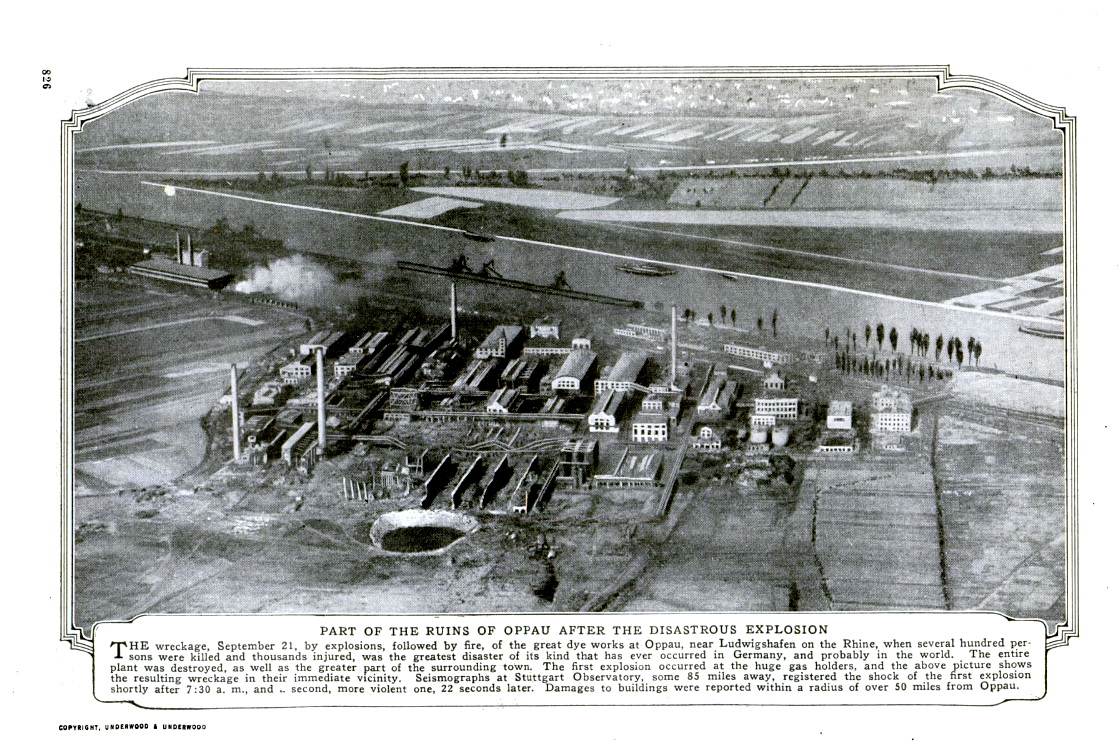
You’ll see the death toll written as both “at least 560” and “561.” The figures aren’t in conflict. The official casualty tally recorded 561 dead; conservative summaries round to “at least 560” because the exact count was hard to fix in a workforce and neighborhood that were partly obliterated, with some victims never fully identified.
Vital Statistics — Oppau Explosion
| Item | Detail |
|---|---|
| Event | Oppau explosion |
| Date | September 21, 1921, ~7:32 a.m. |
| Location | BASF Oppau plant, near Ludwigshafen, Germany |
| Material | ~4,500 t ammonium sulfate nitrate (ASN) |
| Deaths | ~561 (“at least 560”) † |
| Injured | ~2,000 |
| Homeless | ~7,500 |
| Crater | ~90 × 125 m, ~19 m deep |
| Blast energy | ~1–2 kt TNT equivalent |
| Heard | Up to ~300 km away |
† The official record lists 561 deaths; “at least 560” appears in conservative summaries because the count could not be fixed precisely in the destroyed plant and village. The two figures describe the same event.
What Oppau Changed — Safety, Regulation, and a Rebuilt Plant
Oppau forced a hard rethink of how ammonium nitrate materials are made, stored, and handled. The disaster became an early reference point for treating AN-based fertilizers as potentially detonable bulk hazards rather than inert farm chemicals, feeding into later storage-quantity limits, blasting bans on caked stockpiles, and process controls on particle structure and composition.
BASF rebuilt. The company reconstructed the Oppau works and the surrounding housing; by the time the relief effort wound down in 1924, more than 2,000 structures in Oppau and neighboring Edigheim had been repaired or newly built (Source: BASF, 2021). The site remained a working chemical plant. The lesson that traveled furthest, though, wasn’t organizational — it was chemical. Ammonium nitrate’s behavior depends on its physical state, not just its formula, and that insight took decades and further disasters to fully land.
The Molecule That Keeps Exploding: Oppau, Texas City, Beirut
Ammonium nitrate has caused a grim, repeating series of mass-casualty explosions, and Oppau in 1921 was the opening chapter. The same compound drove the Texas City disaster of 1947 and the Beirut port explosion of 2020. Each involved a large stockpile that was assumed to be reasonably safe until an ignition source and the right physical conditions turned it into a bomb.
Texas City is the closest cousin to Oppau, and the comparison is instructive. In 1947, a fire aboard the cargo ship Grandcamp in Texas City, Texas, ignited its load of ammonium nitrate fertilizer, killing at least 581 people in what remains the deadliest industrial accident in US history. Oppau was set off by a deliberate blasting charge in a sensitized porous pile; Texas City was set off by an accidental fire in a ship’s hold. Different triggers, same underlying villain — a huge mass of ammonium nitrate whose danger was underestimated because it usually behaves. Beirut in 2020 repeated the pattern on a waterfront, when roughly 2,750 tonnes of long-stored ammonium nitrate detonated after a warehouse fire.
If you want the throughline: ammonium nitrate is stable until it isn’t, and the conditions that flip it — confinement, contamination, heat, porosity, a strong initiating shock — are exactly the ones that pile up in careless bulk storage. Oppau taught that lesson first. It kept having to be retaught.
For other early-industrial-era catastrophes, see the Halifax Explosion of 1917 and the strange Great Molasses Flood of 1919.
Frequently Asked Questions
What caused the Oppau explosion?
A routine dynamite charge, fired to break up caked fertilizer, initiated a detonation in the silo. A 2016 FFI reassessment attributes the sensitivity to a new spray-drying process that made the ammonium sulfate nitrate porous and created an ammonium-nitrate-rich fine fraction that collected in pockets, turning part of the pile detonable.
How many people died at Oppau?
Roughly 561 people were killed, with about 2,000 injured and around 7,500 left homeless. Some accounts say ‘at least 560’; that is the same toll, rounded down, because the exact count was hard to establish in a plant and village that were largely destroyed.
Why did it explode if the pile had been blasted 20,000 times safely?
Because the material had changed. A new spray-drying step introduced months earlier made the fertilizer porous and segregated a fine, nitrate-rich fraction. The bulk still looked safe, but sensitized pockets now existed. A loosening charge that once did nothing hit one of those pockets and started a detonation.
Was the BASF Oppau plant rebuilt?
Yes. BASF reconstructed the Oppau works and the surrounding town. By 1924, more than 2,000 buildings in Oppau and neighboring Edigheim had been repaired or newly built, and the site continued operating as a chemical plant afterward.
How is Oppau different from the Texas City disaster?
Both were massive ammonium nitrate detonations with over 550 deaths each. The trigger differed: Oppau was set off by a deliberate blasting charge in a porous, sensitized fertilizer pile in 1921, while Texas City in 1947 was ignited by an accidental fire aboard a ship carrying AN fertilizer.
Could an Oppau-style explosion happen today?
It is far less likely for that exact scenario. Blasting caked ammonium nitrate stockpiles is no longer done, storage quantities are regulated, and the porosity and contamination risks are understood. But large AN stores still detonate when badly managed — Beirut in 2020 showed the hazard hasn’t disappeared, only shifted.
Sources
- Wikipedia — “Oppau explosion”: en.wikipedia.org/wiki/Oppau_explosion
- Tor Erik Kristensen, FFI-Report 16/01508 (2016): ffi.no
- U. Hörcher, “Oppau 1921: Old Facts Revisited,” Chemical Engineering Transactions, Vol. 48, 2016: aidic.it
- BASF — “100th anniversary of the Oppau explosion” (2021): basf.com
- ARIA — accident sheet FD 14373: aria.developpement-durable.gouv.fr
- Nature — “The Explosion at the Nitrogen Fixation Works, Oppau” (1921): nature.com/articles/108137a0